Will our nation’s K-12 students be back in school this coming fall? We all hope so. In the midst of a global pandemic, many school districts across the country have shifted to remote learning, online classes, pass/fail assessments, and other ways to continue teaching students when school facilities are closed. What will that mean for the fall semester? How will students, teachers, and families catch up from all they will have lost to the COVID-19 pandemic?
As you might expect, some districts are better equipped than others to handle this kind of disruption. The “opportunity gap” between under-served students and their more affluent peers, already deep and persistent, is widening rapidly as more and more students are learning at home and are at risk of falling further behind in their studies. It is the epitome of inequity to provide mandatory classes that can’t be accessed equally. This situation is tough for everyone, but students from under-resourced communities are once again at a real disadvantage.
Some are calling for schools to remain open, or re-open, in the summer. This would prevent a nationwide learning loss of several months. But, with uneven homeschooling for most of a semester, youth in under-resourced communities are going to need much more than that. They are going to need individualized intensive academic and social health support.
Organizations, including ours, have built and refined exactly these kinds of programs for decades, and the results have been significant. Students don’t fall behind academically; in fact, most move ahead. The solution is a mix of targeted education focused on helping every child succeed. The CARES Act is a rare opportunity for states and districts to direct educational funding to leverage this expertise for their students who need it most.
When we emerge on the other side of this situation, where will we find ourselves? Students from every community will have a lot of catching up to do. Districts will not be able to do it alone. We encourage funders and decision-makers to partner with summer and out-of-school learning programs who have a proven track-record of narrowing achievement gaps so we all can make the path to academic and life success a far more equitable one.
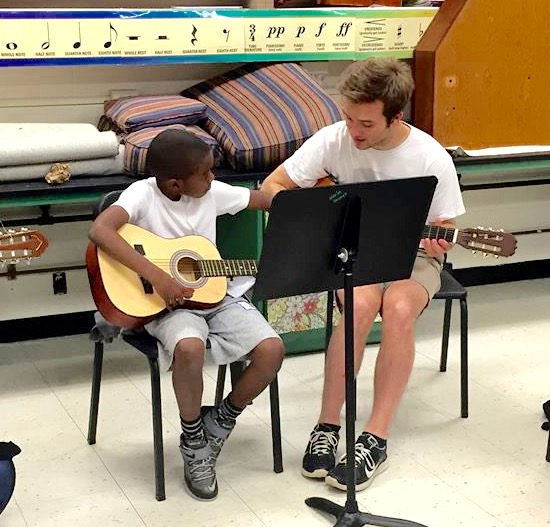
Everyone understands the value of a good mentoring relationship, for both mentor and mentee, but not everyone is quite so sure about how those relationships get started and sustained. At Horizons, we see mentoring is a natural part of the program.
When Josh, a college student who grew up in his local Horizons program from first grade through high school, looks back on his experience, certain people stand out – teachers, friends, and some he considers mentors.
As part of our year-round, out-of-school-time approach to teaching, Horizons believes in the value of summer education, especially for low-income children. We’ve seen first-hand how a high-quality summer program can engage at-risk students with their own learning – from reading to STEM to arts to swimming.
And we’re not alone. This week, CNBC interviewed Margaret McKenna, chair of the National Summer Learning Association (and former Walmart Foundation president), along with Jim Quinn, NSLA vice chair (and retired Tiffany & Co. president) about the importance of summer learning.
Noting that the “summer slide” affects low-income students more profoundly, accounting for some 50% of the achievement gap by the time students reach 9th grade, McKenna sees summer learning as a very effective solution. In fact, she observes, “to invest in summer learning is the best return on investment.”
Her NSLA colleague Quinn agrees. He believes attributes like talent, drive, and ambition are distributed equally in society – but opportunity is not. That’s where summer education (not “summer school”) comes in. Echoing McKenna, Quinn says, “There is no better investment in education, dollar for dollar, than investment in summer learning.”
In over 50 years of successful Horizons programs, we’ve seen, through the students, families, and communities we serve, that summer learning improves how students feel about learning, about their future, and about themselves. One compelling measurement of the positive return on this investment in the future: 99% of Horizons high school students graduate from high school on time, and 91% go on to college or other post-secondary education.
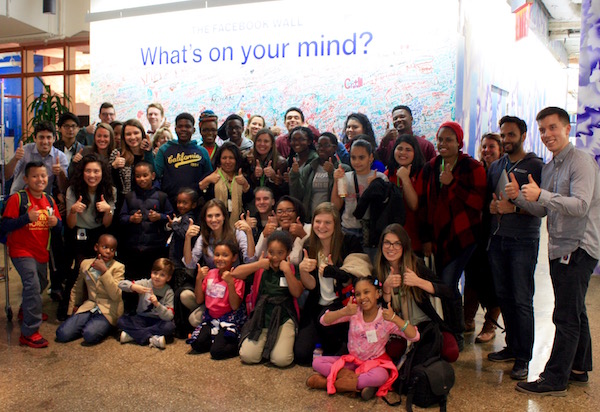
Horizons students give Facebook a big thumbs-up "Like!"
30 Horizons students recently ventured to Facebook’s New York City office to catch a glimpse of their own future. Coming from six different Horizons programs (Horizons at Ethel Walker School, Horizons at Greens Farms Academy, Horizons Newark, Horizons at New Canaan Country School, Horizons at Sacred Heart University, and Horizons at Saint David’s School), the students were able to tour the Facebook office, meet Facebook employees, and learn about the careers they might someday lead.
The students, who ranged from third grade to high school, also got to meet Horizons National’s ambassador, Allison Williams, who told them about her long-standing involvement with, and belief in, Horizons. Students were then able to ask all kinds of questions to a panel of Facebookers moderated by Ms. Williams, and enjoyed touring Facebook’s exciting office space (including several snack stations!).
But Horizons students weren’t the only ones learning new things; many Facebook employees attended the event as well to find out more about Horizons, and about the partnership Facebook and Horizons have built together. It was the first of what Horizons expects to be quarterly Facebook visits, which will focus on specific ages and specific topics important to those ages.
When it was all over, Allison Williams summed it up best: “I cannot wait until this becomes something these students can look forward to regularly. And I love the idea of them becoming comfortable and at ease in the offices of one of the biggest companies in the world.”
She noted that when Horizons takes its students to places like college campuses and workplaces, it “sends a big message about what kind of environments WE see them in the future. It helps them realize that it's okay for them to picture themselves on those campuses too, someday. Being able to spend time at the Facebook office? Unreal. We get to encourage them to dream BEYOND college – and that's amazing.”
All of us at Horizons thank Allison for her help, and thank Facebook for inviting our students in to see, to dream, and to imagine what their future can be.
A new study from the RAND Corporation identifies two predictors for student success in voluntary summer programs: attendance and retention. Simply stated: students with a high attendance rate, and who participate for multiple summers, benefit the most from programs in mathematics and language arts achievement.
Commissioned by The Wallace Foundation, the RAND study sought to find out whether and how voluntary summer programs can help low-income urban students succeed in school. It turns out attendance plays a big role: high attenders in the first summer of the study gained a significant and substantial benefit in mathematics; high attenders in the second summer had better outcomes in both math and language arts.
These findings confirm what we’ve always known at Horizons. Our programs help students from low-income families succeed, and we’ve long stressed the importance of attendance and retention. This summer, our Horizons network-wide attendance rate was 94% – a commitment by our students and families that carries over to the regular school year. As for retention, 87% of our students return year after year.
With students attending at a high rate, and staying with Horizons 6 years on average, the new study confirms just a few of the reasons Horizons is a long-term commitment that works.